
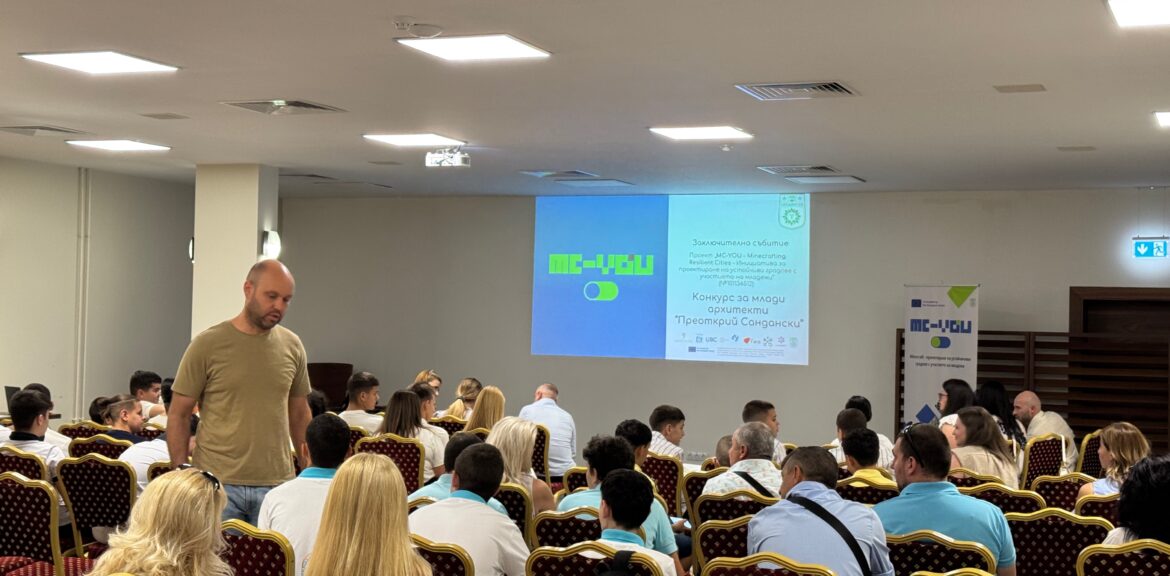
On 26 June 2025, the Municipality of Sandanski hosted the final Sustainability Conference and MC-YOU event in Bulgaria at Interhotel Sandanski (Conference Hall “Sandanski”), bringing together more than 70 participants—policymakers, youth practitioners, teachers, experts, stakeholders and community members—to explore how young people can contribute to more sustainable and resilient public spaces.
The day started with the Young Architects Competition “ReIMAGINE Sandanski”, where student teams presented their Minecraft Education visions, answered questions from the jury, and engaged the wider audience through a public voting process.
The eight youth proposals showcased during the event were:
- Green Paradise Building (I Primary School “St. Kliment Ohridski”)
- New Life for the City Pool and Diving Boards (I Primary School “St. Kliment Ohridski”)
- Dog Paradise (Vocational High School “Kliment Timiryazev”)
- Aquapark “Golden Paradise” (II Primary School “Hristo Smirnenski”)
- Swimming Pool “Sv. Vrach” (IV Primary School “St. St. Kozma and Damyan”)
- EcoSPark (High School “Yane Sandanski”)
- Green Tourist Information Centre (Vocational High School “Kliment Timiryazev”)
- GreenZone Athletics (High School “Yane Sandanski”)
After the awards ceremony, the programme continued with a Sustainability Conference and discussion (13:30–15:00) titled “Designing Sustainable Cities with Youth Participation.” Around 25 participants joined this focused session—many of them already experienced in sustainable urban development and participation, but encountering Minecraft as a serious engagement tool for the first time through the morning presentations.
Instead of formal speeches, the session was designed as an interactive dialogue: a practical conversation about what it would take for youth ideas to move from digital models to real municipal action. Participants discussed feasibility, budgets, regulations, technical constraints and competing priorities—while also recognising the strong sustainability thinking and long-term perspective young people brought into the proposals.
Feedback from the conference was positive and inspiring, as participants valued the honest, realistic tone and the cross-sector exchange among municipal staff, educators, NGOs, and professionals. Suggestions for future follow-ups included dedicating more time to concrete mechanisms (e.g., how youth proposals can be integrated into planning documents) and creating opportunities to track what happens with the ideas after the event.